What is autism?
What is autism?
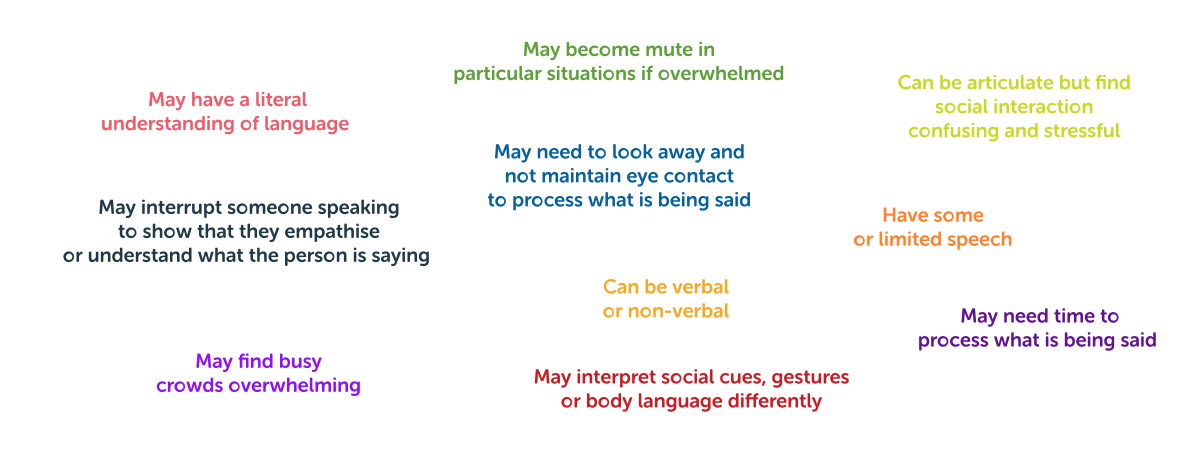
Autism is a lifelong neurodevelopmental difference that impacts on a person’s social communication, social interaction styles, and how they perceive and process information about the world.

What we understand

Social communication, social interaction and how we process and experience the world has a fundamental impact on how we function and cope in everyday life. They are essential skills that help us develop friendships and relationships, understand our own and other peoples’ emotions and why people react/respond in a particular way, recognise safe and unsafe people and situations, and cope with uncertainty and change. Autistic people experience fundamental differences in these areas, which can create stress and confusion and breakdowns in communication between autistic and non-autistic people..

The core features of autism are currently categorised within two broad areas of development:

It is the experience of persistent challenges within these core areas and the distress that can often accompany these differences that usually leads parents to seek an autism diagnostic assessment for their child. People can get diagnosed in childhood or later in adulthood.

SENSORY PROCESSING DIFFERENCES

Many autistic people also experience sensory processing differences such as heightened or lowered sensitivity to noise, touch, taste, smell, visual information, body awareness and movement. These sensory differences can lead to stress and anxiety such as the experience of noise levels being painful to the autistic person or the sensation of someone’s touch lingering long after the person has touched them causing the autistic person discomfort.

Autistic people also often describe their sensory processing differences as being an important factor in maintaining a good sense of emotional wellbeing. For example, particular clothing and textures may be soothing and regulating for some autistic people, colours and shades of light may create a sense of joy and elation for others whilst others may experience positive emotions with preferred music or smells. It is important to recognise this and build in positive sensory experiences into autistic peoples’ everyday routines where possible.    

People's Stories

James' Story

Emily and Nathan's Story

Autism and the spiky profile

Although the core areas of development mentioned above are impacted in different ways in autistic, each person will present with their own distinct “spiky profile” of needs, strengths, abilities and differences. Some autistic people may require specialist support in various areas of their life, such as in education and learning, personal care, and independence. Whereas other people may experience more mild or subtle challenges in life, and may require less intensive support. Many autistic children and adults can excel in specific areas of interests such as music, engineering, computing, and other creative arts. Attention to detail, punctuality, compassionate, diligence and insightfulness are just some of the qualities that many autistic people have.

emerging ideas about autism

Autism is a widely debated subject. Many people, particularly the autistic community, advocate that descriptions of autism should move away from a ‘deficit model’  to a ‘social model’ of disability. This shift in thinking focuses on the central role that systemic barriers, lack of understanding of autism and negative attitudes of others towards autistic people as having a central role in the difficulties that autistic people experience.

See below for more recent emerging ideas about autism by Dr Damian Milton- Autistic Academic.

Initially coined by Judy Singer in 1998, the term ‘neurodiversity’ was based on the concept of Biodiversity, with the idea that diversity helps to sustain an ecosystem. In her thesis, she explored whether it would be better to see neurodivergent conditions in terms of a social minority. The idea of neurodiversity was then taken on by other writers, often utilising an approach more aligned with a social model of disability.
In 2014, Nick Walker suggested using the terms ‘neurodiversity’, the ‘neurodiversity movement’ and the ‘neurodiversity paradigm’. In this sense, neurodiversity is stated as a simple fact of life, that all people develop somewhat uniquely without placing a value judgement on that development. The ‘neurodiversity movement’ has been used to describe those arguing for equal human rights for neurodivergent people. The ‘neurodiversity paradigm’ refers to a set of ideas that argue that such diversity is a natural and valuable form of diversity, and that there is not one ‘normal’ way in which a person’s brain develops.
The term ‘neurodivergent’ refers to people who are deemed outside of social expectations that are generally considered ‘normal’ or ‘typical’.

By Dr Damian Milton, Autistic Academic, University of Kent

Coined by the autistic academic Dr. Damian Milton, the theory of the ‘double empathy problem’ suggests that rather than locating the issue of social interaction difficulties and breakdowns in communication as solely due to autistic ways of thinking and ability to understand others, that there is the potential for mutual incomprehension. Due to both biological and social influences, we all experience life in our own unique ways (at least to some extent), yet when interacting with others with a very different understanding and perceptions about the world, such breakdowns are more likely. Whilst such problems can occur between any two people, this can be particularly the case between autistic and non-autistic people (and particularly with others one has had less social contact with). The empathy problems are said to be ‘double’ as both parties may struggle to understand each other.

In recent years there has been a growing body of evidence to support this theory. Relating to practice, it reminds all of us to be humble in our interpretations of others, and the effort required to build rapport. This is even more so the case when interacting with people who may struggle to communicate using formal language.

By Dr Damian Milton, Autistic Academic, University of Kent  

Everyone is unique and have their own identity

The term ‘heterogeneous’ is often used to describe the autistic population because of the large variability of how the main features of autism can manifest in each child, teenager, or adult. It is important that families, professionals, and the wider population are educated about this. A lack of understanding of this can often leave autistic people at risk of not getting diagnosed, getting mis-diagnosed and not getting the right support at the right time when they need it.

A large number of the Autistic community identify as trans-gender or gender non-conforming.

Good support

Many autistic children and adults will thrive better when around people who are supportive, who have a good understanding of autism, and can effectively adjust their own communication and interaction styles. Autistic people can also thrive when in physical environments that are adapted to their specific needs such as having a quiet space to go if things are too much, comfortable lighting, expectations and rules made explicit through using visual supports such as checklists, schedule boards and to-do lists and using colours that the child or adult prefers to decorate the room.  Some autistic children and adults may benefit from the use of Augmentative and Alternative Communication or AAC.

Our Stories

Ashlie's story

My name is Ashlie. I have a nearly 7-year-old child who is currently still waiting for Assessment. I’ve been involved with Hope for Autism for a year and a half or so, in this time I have taken part in a good few training courses. Last year I took park in the five-week Cothu course (awesome parenting program) this training was developed by and from parents that are Autistic. Week 1 - Intro to neurodiversity, looking at experiences and myths. Week 2 - What it feels like to be autistic looking at senses. Week 3 - Parenting autistically, looking at things like mealtimes and different aids that can be used to help autistic people regulate etc. Week 4 - Was looking at self-care for care givers. Week 5 - Happy parents’ happy child. Looking at acceptance and self-belief, there was lots of resources available from books, podcast and place. Going along to a new course is always very nerve-racking but went along anyway as we want to support our children. I had nothing to worry about, everyone was super friendly and all of us had a common connection. Lovely to start the day of with a nice cuppa and chat with likeminded people, there was plenty of discussion and breaks. Fiona who delivered the session is very friendly and knowledgeable of the course; you can tell she’s well planned and executes the session. She’s always available for a chat. I believe that whoever from Hope delivering the training, will do the exact same. I think the biggest thing I learnt was that there is not one same autistic person, and that looking after yourself as a parent is allowed and needed to help you assist your wonderful child. There is lots of new language within the course but don't panic as it’s all explained. Really glad I went along, it allowed me to put in new routines, and changed my whole thinking of how my child sees the world. Thank you for the opportunity and good luck to everyone. Ashlie

Claire's story

My name is Claire, I'm a mum to two girls aged 11 and 8. My oldest daughter is autistic and my youngest is waiting to be diagnosed. I knew deep down since my daughter was a toddler that she was different from other children her age. My family, friends even some professionals told me she's a toddler stop looking for problems and enjoy being a mum. As my daughter got older things were getting more challenging and I still couldn't shift the feeling something was off but back then I didn’t know what autism was so I kept pushing through each day praying things would get better and things would change. When my daughter started school things began to escalate, I was mentally and physically exhausted asking for someone to help me because my child was violent, destructive, self harming and not sleeping anymore. I had meeting after meeting with the school just to be told over and over again your child is fine. School didn’t see any of the challenges because my daughter was great at masking. These comments over the years of primary school broke me as a person and as a mum. I was so mentally exhausted from the constant back and forth and nobody listening to us I was broken I didn’t want to live anymore. My daughter hit what we know now as an autistic burnout and didn’t attend school for 11 weeks. We couldn’t get her to leave the house even looking at her uniform caused meltdowns, it was soul destroying watching my child suffer and no one would help us. At the start of April 2024 when I was in a really bad place. This is when I found HOPE and the Parents Support Group in my area and wow I was welcomed with open arms! The women were so lovely and I saw that I wasn’t alone. I wasn’t the only one going through this hell, there were other parents going through similar and worse situations. I was never once judged, never made to feel worthless, all my concerns and opinions were validated, I felt like I belonged again. I felt a weight begin to lift off my shoulders that I cried. I continued to go to the group every week and got to know all the parents. Kirsty and Eve from HOPE who ran the group informed me of all the training courses and workshops HOPE have to offer. I was on a mission to find out as much as I could about everything my child was going through. Over the last 7 months I have completed every training course and workshop HOPE for Autism have to offer and WOW I am loaded with all the information I need to help my daughter. I now say I'm a force to be reckoned with!! I now know how to tackle schooling issues and day to day issues with my children. I don’t listen to unhelpful help, I'm stronger now and I cannot thank HOPE for Autism enough. This charity is the miracle that we need. I truly stand by my words 100% when I say if it wasn’t for HOPE, the training & workshops they provide, for Kirsty and Eve and all the parents at group and Fiona I wouldn't be here, my children wouldn't have their mum. HOPE for Autism will always hold a specially place in my heart so much so I wanted to give back. I am in such a better place in myself and being full of all the information I decided to apply for an assistant position with HOPE. It’s only been 2 weeks working with HOPE and I love it and it's the best decision I made. My daily life hasn't change in regard to school issues and my daughter struggling but I have changed as a person, a wife and a mum and I now have the tools and strategies I need to help my children and it’s all thanks to HOPE for Autism. I will be forever grateful.

our Partners